
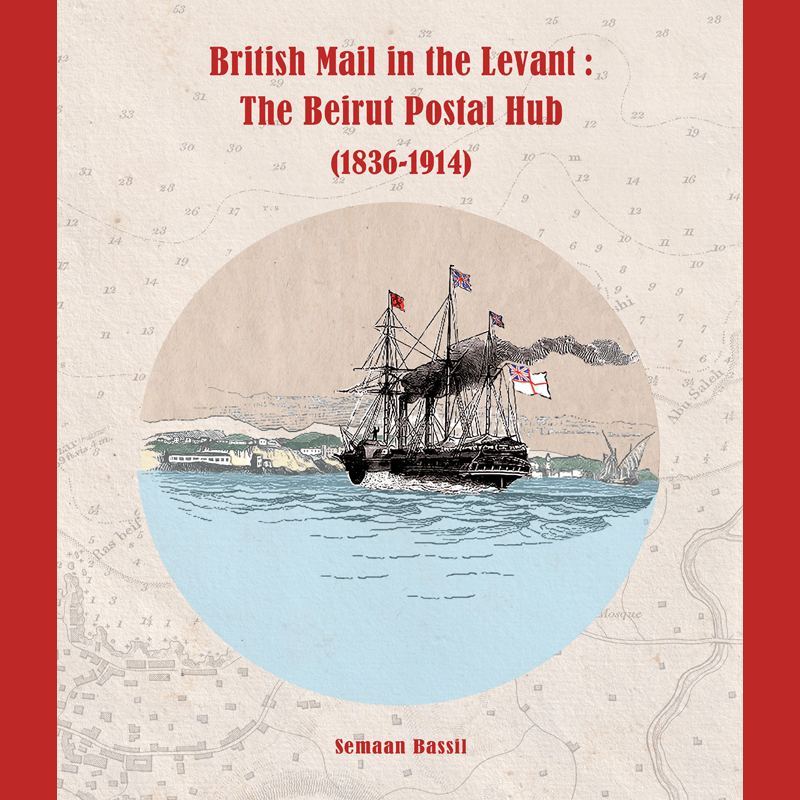
British Mail in the Levant: The Beirut Postal Hub (1836–1914)
The new book by Semaan Bassil, British Mail in the Levant: The Beirut Postal Hub (1836–1914), dives into intensive research on British postal history in the region. Using primary and secondary sources extensively, it contextualises and analyses postal artefacts while offering rich, detail-oriented historical information, focusing on the influence of geopolitics and the positioning of Beirut for British postal communication over 75 years.
It starts in 1836 with the conveyance of British mail to and from India by the British Admiralty via Beirut, then recounts the British packet agency in that city, handing mail for Syria, Mesopotamia, and Persia from 1840. It goes on to describe how the General Post Office in London strategically decided to subcontract different liners in 1872 to speed communication with Beirut, before converting its packet agency in 1873 into a post office, in parallel with the erosion of Britain’s world economic preeminence. It ends with the start of the First World War in 1914, when all foreign post offices closed.
Woven throughout the book are numerous examples of pre- and post-UPU analysed British mail and, notably, the study dedicates a full chapter to listing and analysing British mixed-franked postage mail used only in Beirut (1873–1876) for expediting overseas mail via Alexandria. The publication ends with a list of postage stamps used at the British Post Office in Beirut, of which several are unrecorded in any publication, including catalogues.
The 292-page book can be obtained through the author at bassil.semaan@gmail.com or through info@cedarstamps.com. It is priced at 75 USD, excluding shipping. The net proceeds will be donated to CHANCE (Children Against Cancer).
…

