
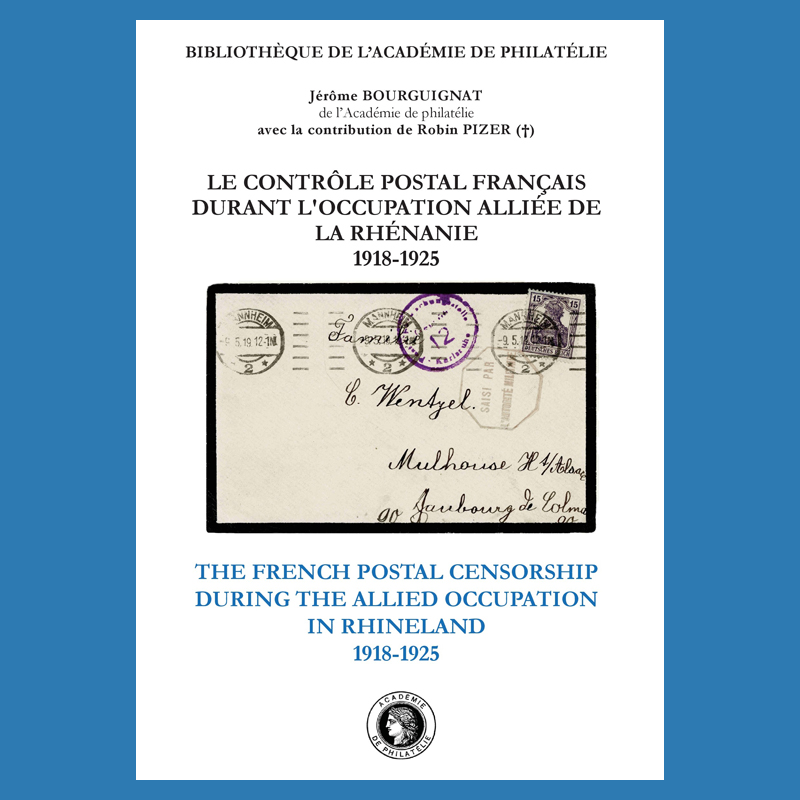
The French Postal Censorship During the Allied Occupation in Rhineland 1918–1925
The author had already published, in 2010, a work on French postal and telegraphic censorship during the First World War. The issue of the occupation of Germany was only briefly addressed there. Since then, he has conducted further research in the archives of the HCITR and the Service Historique de la Défense (French Defence Historical Service). The author also benefited from the collaboration of Robin Pizer (FRSPL), a specialist in German sources. His collection, assembled over more than fifty years, has significantly enriched the iconographic material. This research has made it possible to identify new handstamps and establish their periods of use.
After the Armistice, the Allies extended to the occupied Rhineland the postal censorship that had previously existed in the army zone. New postal censorship commissions were established there. Postal communications, initially prohibited, were gradually authorised. In France, postal censorship was abolished in August 1919, but it was maintained in occupied Germany in a reduced form. From January 1920 onward, the HCITR supervised this censorship, which became focused on specific individuals. The opening of letters was sometimes carried out discreetly so as not to arouse suspicion. At the same time, the German authorities introduced exchange controls to limit capital outflows. The Allies initially refused to allow German post offices to be established in the occupied zones, as they suspected the existence of a “black cabinet” clandestinely opening Allied mail. This resulted in a confusing situation, with letters being opened without official markings. Tensions emerged between Allied and German authorities over these practices. The occupation of the Ruhr (1923–1925) intensified these conflicts and severely disrupted postal services. After the London and Locarno Agreements, these controls declined and gradually disappeared.
Bilingual English/French, softcover, 21cm x 29.7cm, in colour, 146 pages, 102 illustrations.
Price: €25 per copy + €13 for postage (Benelux, Germany, Italy, Portugal, Spain); other countries contact academie.philatelie@gmail.com by email to request postage costs.
Orders addressed by email to academie.philatelie@gmail.com including your delivery address.
Payment: Bank transfer to ACADEMIE DE PHILATELIE – IBAN: FR85 2004 1000 0101 4366 3L02 062 — BIC: PSSTFRPPPAR
PayPal to academie.philatelie@gmail.com (please add €2 for charges).

